What if they had a protest and everyone came?
Mon. July 4, 2005Categories: Abstract Dynamics
What kind of protest is it that everyone agrees with?
If you weren’t already suspicious of the dull unanamity that coalesced on Saturday, reflect on the fact that the Russian show only happened because Putin didn’t want to be the only G8 leader whose country did not have a Live 8 gig. That fact alone reveals that the relationship between the current ruling elite and their ostensible opponents in the entertainment biz goes far beyond complicity.
Live 8 rests on two ‘libidinal fallacies’.
The first is obvious: it ignores the systemic and abstract nature of the geopolitical situation. It really isn’t the case that ‘eight men in a room’ can ‘change history’ simply by an act of will. Beyond the sentimental bluster, everyone knows that, but Live 8 depends upon a fantasy that there are two types of subject who need to be enlightened: the Subject Who Does Not Know (and whose ‘awareness’ is to be raised) and the Subject Who Knows but Who Doesn’t Care. But who are these people? Who, exactly, needs to be ‘made aware’ of the fact that Africa is desperately poor? And does anyone, even those who buy into the cheap off-the-shelf caricature of Bush as a dumb chimp, really think that he, personally, deliberately chooses to inflict starvation on African children? More to the point, does anyone really think that, on the level of personal morality, Bush is any different from the billionaire Pop Stars so histrionically raising their fists against him and wagging their fingers at us? That is to say: if there is some sort of moral dividing line, would you really want to place Bush on one side and Elton John and $ Bill Gates on the other?
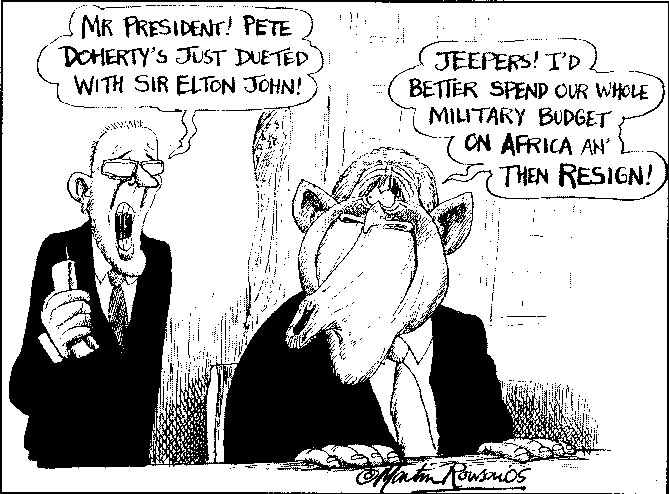
It is not that Live 8 is a ‘degraded’ form of protest. On the contrary, it in Live 8 that the logic of the Protest is revealed in its purest form. The Protest impulse of the 60s posited a Malevolent Father, the harbinger of a Reality Principle that (supposedly) cruelly and arbitrarily denies the ‘right’ to total enjoyment. This Father has unlimited access to resources, but he selfishly – and senselessly – hoards them. Yet it is not capitalism but Protest itself which depends upon this figuration of the Father. It goes without saying that the psychological origins of this imagery lie in the earliest phases of infancy. The hippies’ bucolic imagery and ‘dirty Protest’ – filth as a rejection of adult grooming – both originate in the ‘unlimited demands’ of the infant. A consequence of the infant’s belief in the Father’s omnipotence is the conviction that all suffering could be eliminated if only the Father wished it. (In terms of Live 8: if only those 8 men yield to our demands, all poverty could be eliminated forever!) The demand for total enjoyment is actually pretty indiscriminate: the Protest could just easily be against war (bummer maaaan) or against being charged for going into a festival (hey, breadheadzzzzzzz, don’t be heaveeeee….)
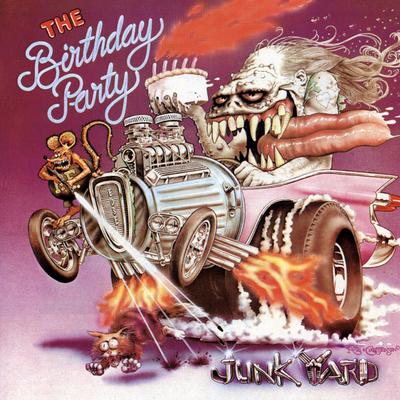
Indidentally, one of the successes of the latest global elite – the Social Democrats – has been their avoidance of identification with the figure of the hoarding Father, even though the ‘reality’ they impose on the young is substantially harsher than the ‘reality’ they protested against in the 60s. In this sense, Bush is a godsend for Blair, since Blair can pose as the ‘really realistic’ representative of Social Democratic moderation ‘winning concessions’ from the obscene excesses of Bush, the Junkyard King of Amerikapital’s hideous fusion of id and superego. (The reference to the Birthday Party is not idle here. Oddly, their Junkyard strikes me as an uncannily prescient psychoanalysis both of Bushite Amerika and the role that it plays in everyone else’s fantasies, ‘Big-Jesus-Oil-King down in Texas drives great holy tanks of Gold/ screams from heaven’s Graveyard/ american heads will roll in Texas/ roll llike daddy’s meat…’)
This brings us to the second fallacy. What is being disavowed in the abjection of evil and ignorance onto fantasmatic Others is our own complicity in planetary networks of oppression. What needs to be kept in mind is BOTH that capitalism is a hyper-abstract impersonal structure AND that it would be nothing without our co-operation. As I will never tire of insisting, the most Gothic description of Capital is also the most literal. Capital is an abstract parasite, an insatiable vampire and zombie-maker; but the living flesh it converts into dead labour is ours, and the zombies it makes are us. Determinists of both a neo-liberal and anti-humanist bent (believe it or not, it is not unheard of for such positions to co-incide within the same person, proving that Marx wasn’t wrong about the essentially contradictory nature of capitalist ideology) merely echo teleo-Marxism at its most eschatological when they insist that what the meat (or human) components of the Capital machine are of no consequence since the total triumph of Capital is historically Inevitable.
The question of what Capital wants from us requires answers at a number of levels: economic, psychonalytic, and perhaps most pressingly, theological. In any case, it is clear that, for the moment at least, Capital cannot get along without us. It remains the case, however, that we can get along without it. The parasite needs its ‘mere conscious linkages’ but we do not need the parasite. In addition to anything else, to ignore the crucial functioning of the meat in the machine is poor cybernetics. The denial of human agency is an SF fantasy, albeit one that is everywhere realising itself.
But to reclaim that agency means first of all accepting our insertion at the level of desire in the remorseless meat-grinder of Capital. Capital is not something imposed upon us by Bush; it is we who are hooked on the ‘garbage in honey’s sack’, unable to kick the habit of returning to the Big Jesus Trashcan for another hit of feel-good junk.
It also means raising the price – libidinal, personal, monetary – of agency. The repeated claim from onstage multi-millionaires that the audience were going to ‘change history’ simply by turning up and tuning in cheapens agency in every sense. Participating in a narcissistic, self-rigtheous Spectacle is not ‘doing something’. Tony Parsons, of all people, made the very good point in The Mirror today that the generation of the Thirties and Forties did not expect Crosby and Sinatra to change the world – but, as he says, many of them had either risked or given up their lives to change things.
Withdrawal from the Capital Matrix entails an unplugging that will seem painful to nervous systems commensurated to the Reality-Pleasure Principle. Partly it means giving up the reassuring comforter of the Bad Father Figure and facing the fact that the G8 leaders are not capable of legislating away all planetary misery, but are ‘old men at the crossroads’, Capital’s meat puppets not its masters. There is a sense in which it simply is the case that the political elite are our servants; the miserable service they provide from us is to launder our libidos, to oblgingly re-present for us our disavowed desires as if they had nothing to do with us. If anyone is in charge in Kapital it is Oedipus Rex, i.e. us. (‘I yam the King!’ as Cave caterwauled on ‘Junkyard’. Yes: the junkie as monarch, that’s capitalist sovereignty.) The political ‘reality’ that Bush and the others will no doubt blame their failure to act upon is not just an ideological smokescreen. It is the reality constituted by the desires of that selfsame Live 8 crowd who, when push comes to shove, will not pay extra taxes, will not give up cheap flights or car use, will not make a stand against inequity and stupidity at work if it means compromising their interests and those of their famileeeee and yet who expect global crises to be magically solved by 8 stooges in a room.
The great benefit of Lacanianism is to reject both the party of the Infant (‘you want new masters, and you shall have your wish’ as Lacan told the student protestors of the 60s) and the party of the Father (the empircomongers who try to sell the Symbolic as the only Real). There must indeed be a demand for the Impossible, but an Impossible which does not correspond with the definition provided by either party. It is not a question of total enjoyment, but of the not-all, a sober psychosis, lessness….
[…] https://k-punk.org/what-if-they-had-a-protest-and-everyone-came/ […]
[…] What is meant by this is that a true accelerationist wants to affirm capitalism’s own outward-facing orientation — and this orientation is a central insight of Karl Marx. The desire that fuels a capitalist system is insatiable but, in constantly reaching beyond itself, it also puts itself at risk. It threatens its own destruction every time it attempts to assimilate a new outside. In that sense, capitalism does not refer to some state of things outside ourselves. Capitalism is nothing without us — that is, our desires — and so, as an aside, I want to be clear here, when I say capitalism in this talk, know this refers to the entire system, from the oppressive forces of the state and the economic systems that escape its boundaries, but also ourselves and our internalised sense of our bordered constitution. Capital and subject are, in this way, horrific mirrors of each other. To quote Mark Fisher again: […]
[…] To conclude, Pokemon Go is the pre-simulation that reproduces the reality, it produces the virtual as much as the real; it crowd controls, it coordinates. Computing human parameters in a simulation becomes a redundancy if the game itself can directly compute and simulate human beings in the physical world. The question is, what is it simulating? Just like Mark Fisher forestalled back in 2008 in his book ‘Capitalist Realism’ before he took his own life: what if you held a protest and everyone came? […]
[…] about a general strike in support of Palestine, taking place for many tomorrow. It reminded me of that excellent k-punk post on Live 8 — the sycophantic spectacle from what feels like another universe where some people really […]
[…] What I want to talk about today is patchwork and accelerationism, and how they are intrinsically related, but that feels like a difficult task at the moment…In fact, I had a whole other talk planned for today, presenting some recent research on this topic which goes back to the naturphilosophie of Schelling and Fichte and how post-Kantian debates around theodicy and the temporality of evil offer us something today in how we think about capitalism, filling in the blindspots of some more explicitly Kantian thinking along these lines. As thrilling as that might sound, it felt too far removed from the events of the last few weeks.One of the major talking points of the last week has been the appearance of the word “accelerationism” in the manifesto of the perpetrator of the Christchurch shootings in New Zealand, a xenophobic and particularly Islamophobic terrorist attack which killed 50 people. Suffice it to say, it’s been a bad week for the discourse.I wrote a quick blogpost about this the other day, wanting to address this situation head on, writing about how this shooter’s form of “accelerationism” should be completely unrecognisable to an accelerationist who has been influenced by this thought as it has emerged from its source — and I think that’s true whether you’re on the left or the right.This was a post that looked inevitably trivial in the face of the horror of that attack. Of everything that needed to be said in the aftermath of that event, the defence of one obscure word from the peripheries of political philosophy, which appeared on just one page of a meandering and incoherent manifesto, might suggest that my priorities are in the wrong place. But I also think that it’s important that we firmly hold onto the terms and politics we have developed for ourselves. To denounce a word in the face of its abhorrent appropriation feels too much like giving in and being complicit in the rejection of radical politics that that attack really represents. This kind of politics wants to override the intentions of progressive discourses, lest we forget the shooter defended his ethnonationalism on environmentalist grounds also. This is what the enemy wants — the dilution of the words and signifiers that we think hold power for us. With that in mind, I’d personally much rather take a stand on what I believe in and its fundamental rejection of the shooter’s politics than let it all melt away, just like everything else around us, into the nondescript swamp of PR politics. This extended form of defence is — admittedly — something I’ve engaged in far too much over the last week and, frankly, I’m exhausted by it now. Twitter is probably not the best place for it anyway and today I feel, in many ways, completely done with Twitter. What’s worse, though, is that this prospective counter-discourse appears to have even more of an uphill climb ahead of it than I initially anticipated. Gregory Marks, who goes by the handle @thewastedworld on Twitter, recently did noone any favours by creating a Twitter bot that retweets all mentions of “Accelerationism”. Gregory is a really great writer and I cast no shade on him in pointing to his new creation, even if he is the Doctor Frankenstein in this situation, because, as cursed as his Twitter invention may be, it has revealed the enormity of a pill that was already difficult to swallow — that is, that the shooter’s particular brand of accelerationism seems to dominate Twitter in many respects, and that’s on both the right and the left. Regarding the latter, I’ve also written against these widespread left-wing misunderstandings of accelerationism recently, in particular how they have proliferated more locally, but I personally had no idea just how far these misconceptions spread across the internet. These is certainly not a form of this politics that I come across online or in my everyday life.This talk isn’t going to be a recounting of those defensive arguments but this is nonetheless the background onto which this talk has all written and the message central to those previous posts bares repeating here before I continue, because it demonstrates the mechanism just discussed in the Q&A with Enrico on the hegemonic consolidation of myths — in that here we see an idea of accelerationism which is abhorrently violent and superficial but which we can interpret as only helping to embolden present ideological hegemonies by ejecting the radical outsideness of accelerationism, and in many ways calls for change in themselves, out onto the scorched earth of political extremism. This is a message has direct implications for patchwork politics as well and which we can see examples of around the world. Palestine might be the most obvious example, where patch-adjacent demands of self-determination are dismissed as being complicit in terrorism and must be denounced across all political lines.So, hopefully, especially in present company, I hope it goes without saying that the shooter’s form of accelerationism is utterly superficial, calling for nothing more than the intensification of social change in order to combat social change. These so-called “accelerationists” simply want identity politics to eat itself, and I mean that quite literally. They worship the political figure of the ouroboros — the snake that eats its own tail (likewise referred to by Enrico in his talk); it is a form that is self-destructive and self-constituting in equal measure. It is a sort of tactical destruction and fear-mongering that aims to keep things exactly where they are in their frenzied stasis.This is not the accelerationism I know and study. It is, in fact, fundamentally opposed to this way of thinking. It is precisely this in-grown process of self-destruction and self-constitution that accelerationism points to and tries to exit. It sees the ouroboros for what it is and looks for ways to kill it.This is something already explored by Enrico in his talk — this sort of in-grown logic of performative exit which is, in fact, the spectacle of an already hegemonic system flexing its own limits, and as Enrico also pointed out, this is something I’ve written about a few times recently.I personally adhere by the Mark Fisher definition of accelerationism. In a 2014 essay entitled “Postcapitalist Desire”, Fisher defines accelerationism as follows:“Capitalism is a necessarily failed escape from feudalism, which, instead of destroying encastement, reconstitutes social stratification in the class structure. It is only given this model that Deleuze and Guattari’s call to “accelerate the process” makes sense. It does not mean accelerating any or everything in capitalism willy-nilly, in the hope that capitalism will thereby collapse. Rather, it means accelerating the processes of destratification that capitalism cannot but obstruct.”What is meant by this is that a true accelerationist wants to affirm capitalism’s own outward-facing orientation — and this orientation is a central insight of Karl Marx. The desire that fuels a capitalist system is insatiable but, in constantly reaching beyond itself, it also puts itself at risk. It threatens its own destruction every time it attempts to assimilate a new outside. In that sense, capitalism does not refer to some state of things outside ourselves. Capitalism is nothing without us — that is, our desires — and so, as an aside, I want to be clear here, when I say capitalism in this talk, know this refers to the entire system, from the oppressive forces of the state and the economic systems that escape its boundaries, but also ourselves and our internalised sense of our bordered constitution. Capital and subject are, in this way, horrific mirrors of each other. To quote Mark Fisher again: […]